Thailand, Truth, and Transformation

What the Year of the Snake Taught Me About Shedding, Stillness, and Starting Over after relocating to Thailand at the end of 2024.

In the Chinese zodiac, 2025 was the Year of the Snake.

The snake doesn’t chase. It doesn’t rush. It doesn’t beg for understanding. It simply waits, sheds, and moves forward, lighter, sharper, and more aligned with its next evolution. That energy is what defined this past year for me.

This certainly wasn’t a year of big, loud wins. It was a year of quiet necessary shedding whilst solidifying my energetic sovereignty.

It was the year I let people, and places completely fall away. What didn’t align was allowed to exit without resistance. That’s the power of the snake, maintaining self possession without pursuit. Making the year 2025, a year of my truth.

Relocating to Thailand fostered strategic stillness, as I entered a completely different frequency. One that forced me to slow down, remove impulses and simply observe. Seeing clearly the parts of my life and business that were still being powered by outdated expectations. I allowed things to unfold as I sat in the discomfort of reigning in the old impulse to save rather than serve.

Thailand gave me stillness, but also redefined my standards. I came to realize that not moving is sometimes the most powerful move . Simply choosing to remain coiled in the stillness of my inner truth, as I sharpened my wisdom, heightened my intuition, and enhanced my adaptation, in preparation for what’s coming next.

This meant I had to let go of being to one who explains and entertains everything. Foregoing the need to be understood by people who are not spiritually, emotionally, or energetically equipped to be apart of the next level of my becoming.

I embraced detachment from how people interpreted me, and stop performing relatability. My clarity became my consensus. Finally understanding that the snake doesn’t seek permission to transform, it just does.

Now I am no longer dragging dead weight. I am emerging with greater precision, and silent certainty.

I’ve eased into the release of business relationships that no longer serve. Understanding that sometimes it’s not only betrayal that ends a business partnership, but mismatch does as well, as I began to feel the weight I was holding from those who benefitted from my brilliance but couldn’t match my pace, my systems, or my integrity.

My soul no longer had the capacity for dynamics that relied on my over functioning, and that clarity is what cut the cords of my long standing hope, that one day there would be change in those who only engaged with urgency and chaos, and only expected my “yes” and disrespected my “no”.

Clarity allowed me to see what I had confused for loyalty. It was the attachments to people who only called when something is on fire, and expect my instant rescue, attaching to my energy but not respecting my expertise. Seeing me as a FX solution, but not a industry strategist, and demanding results while rejecting the very systems that create those results.

That weight stopped me from giving my nervous system away to people who are addicted to chaos. Leading me to choosing boundaries over burnout, requiring preparedness and excellence from those who I align with and that is what changed everything.

Underneath all the structure I have built, across multiple companies, countries, and portfolios, there was a version of me that was tired. The version that made the urgency of others my personal emergency. But when my health interrupted and I wasn’t physically strong enough to keep going, I realize that urgency is not the same as importance. I was then forced to outgrow the entire system I was holding up. And that’s the part most people never see: the moment when you realize that what you built, no longer feels like yours when it is filled with intrusive noise.

So I let it collapse, so it can transform. Not because I didn’t care, but because I was forced to care for and carry myself alone.

I let the gaps show.

I let people misunderstand me.

I let things fall away without trying to fix them.

And in that space, cleared of the noise, and I began again.

Now I operate differently. No longer confusing proximity with partnership, urgency with importance, or emotional debt with loyalty.

I now embody heightened discernment. Realizing some people were only committed to the version of me that was accessible, over-functioning, and always available.

I’ve now redefined client pathways. Restructured systems, and shifted the energy operationally, and with that finally creating the structure to support the vision that has been living in my head for years: a vertically integrated group of companies operating globally.

Now when I wake up in Thailand and fly to meet developers in the Philippines, walk through factories in China, speak in classrooms in Cambodia, review Airbnb’s in Vietnam, and attend global networking events in Malaysia. I am anchoring a new paradigm. One where Caribbean entrepreneurs aren’t dependent on outdated systems, and mindsets. Where excellence is the standard, and we don’t have to explain our expectations.

This is transformation in motion.

Its was the year I accepted softness with shedding as a strategy. I stopped performing strength, and managing relationships that only functioned if I was available and always accessible.

I stopped over-explaining.

I started slowing walking away, because shedding doesn’t have to be dramatic.

It can be sacred.

It can be strategic.

It can be done in silence, without the need to broadcast the before and after.

There are no prizes for being palatable.

No medals for over-delivering while under-supported.

No reward for staying where you’ve already outgrown your role.

This was the year I decided: I no longer need to be accessible to be impactful.

The version of me walking into 2026 is not louder. It’s clearer. I’m operating with vision, and entering rooms that can hold my frequency, so I can help build tables and create for others like myself to have a seat.

As we enter into 2026, the Year of the Horse.

Here’s to not carrying what no longer belongs on the journey. Moving with purpose, with strength, and unshakable freedom.

To riding in on truth with systems and sovereignty.

So as the Year of the Horse approaches, the snake has now shedded what couldn’t move forward and further with me, leaving only what could accelerate.

Precision. Discernment. Systems. Sovereignty.

The Horse doesn’t undo the stillness. It moves because the stillness made direction unavoidable.

Thriving Together: The Power of Proximity

For years I have experienced the law of proximity, as I lived between South Florida and Trinidad and Tobago. I often traveled to South America, the Middle East, Africa, Asia and now South East Asia — each region shaping me in a different way. What most may view as “not settling down”, for me is the intentional curation of proximity that supports the evolution of my consciousness. I have experienced how every environment carries own energy, rhythm, and mindset — and how those invisible borders either expanded or restricted what was possible.

There is power in understanding the law of proximity.

Most people think proximity is about relationships or networking — about who you know or who knows you. But over time, I learned that proximity is far deeper than that. It’s not only about who you’re near, but what systems you’re near. It’s about access, exposure, collaboration, and even the level of awareness that surrounds you.

In Trinidad, I recognized how individualistic and self-preserving the systems had become. So many brilliant people, so much raw potential — but collaboration wasn’t the norm, and support structures were fragmented. Too often, relationships revolved around extraction rather than expansion. You give, you contribute, you serve — but the environment isn’t designed to multiply your effort.

For years, I believed that if I just worked harder, stayed loyal, and gave more, I could shift the environment from within. But what I learned — often through painful experiences — is that effort without alignment becomes exhaustion. Growth doesn’t happen in isolation; it happens through ecosystem synergy.

When I began spending more time in collectivist societies, something clicked almost instantly. Collaboration isn’t an exception — it’s an expectation. There’s an unspoken understanding that collective progress is the foundation of sustainability. Whether it’s in hospitality, manufacturing, or innovation, the mindset is interdependent: when one person grows, the ecosystem benefits.

That realization completely reframed how I view success.

Growth isn’t only about effort — it’s about environment.

Where you choose to position yourself determines what becomes available to you.

We often romanticize “making it” at home — especially those of us from the Caribbean or across the diaspora. There’s a quiet guilt that comes with leaving, with seeking opportunities beyond our borders, as if leaving means abandoning our roots. But what if expansion isn’t abandonment at all? What if the most powerful thing we can do for our home is to grow beyond it?

Because expansion creates access — and access creates impact.

The Law of Proximity reminds us that success isn’t just about talent or determination; it’s about proximity to systems that support your evolution. You can have the skill, the drive, the creativity — but if you’re in an environment that drains you, resists collaboration, or operates from scarcity, your growth will always hit a ceiling.

So, pause and ask yourself:

• Am I in an environment that expands my perspective or confines it?

• Are the people around me driven by creation or competition?

• Does this ecosystem encourage scale or sustain stagnation?

The truth is, your next level might not demand more discipline — it might demand a different environment.

That’s the awareness that has reshaped everything I do — how I build my companies, lead teams, and guide others through my Hospitality Across Borders community. We’re not just building real estate portfolios; we’re creating a global ecosystem rooted in collaboration, excellence, and shared prosperity. We’re proving that opportunities can transcend borders — when you place yourself in proximity to collaboration.

Because proximity determines possibility.

And as I prepare for my first visit to China, to continue the expansion of our operational infrastructure across regions — I’m reminded once again that the right environment doesn’t just change your business; it changes you.

If you’ve been feeling stuck, stagnant, or surrounded by systems that no longer reflect who you’re becoming — maybe it’s not that you need to do more. Maybe you just need to move differently.

Sometimes, your next level isn’t waiting for you to hustle harder.

It’s waiting for you to change your environment.

Why Global Mobility Is The Ultimate Leverage

For years, the idea of global mobility has been painted as a luxurious fantasy reserved for the wealthy or the wildly adventurous. But here’s the truth: mobility isn’t luxury. It’s leverage. It’s the quiet strategy that allows you to reclaim your time, protect your peace, and redirect your energy toward building a life that’s truly yours.

When you remove yourself from environments where the cost of living, and crime keeps rising, your stress automatically decreases, your nervous system begins to recalibrate, and your capacity expands. Time is your most precious, non-renewable resource, and mobility gives you more of it. Every minute you spend fighting inefficient outdated systems, is time being pulled from your growth potential. Global mobility flips that equation. By living in regions where systems work, and society functions collectively, your quality of life automatically improves, you buy back time, and time becomes the foundation for a life of freedom. This isn’t about escaping responsibility; it’s about designing a life of efficiency.

Peace is the new wealth. When your environment is calm, functional, and aligned with your values, your nervous system can finally rest — and that’s where true creativity and leadership begin. Living across borders taught me that peace isn’t passive; it’s strategic. It’s about positioning yourself in places that support your growth rather than drain your spirit. In high-pressure entitled environments, we often mistake stress for productivity. But when you remove unnecessary chaos, your decision making becomes sharper, your energy cleaner, and your vision stronger.

Geo-arbitrage — the practice of earning in stronger currencies and spending in lower-cost economies, isn’t a loophole; it’s a blueprint for scalability. Every bit of currency, whether money or energy, that you stop spending on survival becomes capital you can reinvest into your future. That might look like acquiring property in emerging markets, investing in your education or systems, or expanding your business infrastructure across borders. Mobility gives you options, and options build resilience.

When you move intentionally, you expand your worldview. Your exposure multiplies, your problem-solving deepens, and your network becomes global. You begin to understand markets not from theory, but from lived experience — how people live, think, and create across different economies. Mobility amplifies your power because it breaks you out of local limitation. You stop thinking only in terms of survival and start making decisions from a place of sovereignty.

If you’ve been paying attention, you can feel it, a quiet global migration is underway. People are re-engineering their lives, trading perceived stability for sovereignty, and building wealth through movement, not attachment. Freedom is no longer defined by a passport stamp or a paycheck; it’s defined by choice, where you live, how you work, and who you serve. And the truth is, freedom isn’t found. It’s created.

Mobility is the infrastructure of modern freedom. It’s how you buy back time, build for the future, protect your peace, and amplify your power — all at once. The question isn’t whether the world is changing. It already has. The real question is: are you ready to move with it?

It isn’t about constant motion, its about intentional positioning. It’s the understanding that every destination you choose, every border you cross, becomes part of your portfolio of perspective. The ability to adapt, observe, and build across different countries and economies amplifies your resilience toward global shifts. Those who master movement aren’t running away, they’re building a diversified freedom lifestyle that is free from any one government. In an era where freedom is the new currency, the most valuable investment you can make isn’t just in assets, it’s in the expansion of your own access to global options.

Dynamic Pricing Isn’t Disrespect, It’s Data!

Recently, my team brought to my attention a message from a property owner who was upset about a nightly rate adjustment for her Airbnb listing. She insisted that “we agreed upstairs would never go below $70 a night,” and referenced what she saw online on Airbnb, as proof that something must have gone wrong.

It wasn’t the first time we’ve received that kind of message.

And it won’t be the last — because this isn’t just a one-off misunderstanding.

It’s a symptom of something much deeper: the Caribbean’s short-term rental education gap.

The Fixed-Rate Mindset

Many property owners across the region still approach short-term rentals with the mindset of long-term leasing: set a price and stick to it.

But hospitality doesn’t work that way.

Dynamic markets adjust rates daily based on occupancy, demand, competition, and seasonality.

What that owner interpreted as “an error” was actually revenue management doing its job.

In the Caribbean, that kind of data-driven thinking still feels unfamiliar.

Here, pricing often feels personal. If the system drops a rate by $5, it’s seen as disrespect — not optimization.

That emotional attachment to numbers is one of the biggest barriers to scaling our regional short-term rental industry.

What Dynamic Pricing Actually Means

Dynamic pricing isn’t discounting.

It’s about optimizing yield — maximizing total revenue, not just the rate per night.

In global hospitality, rates fluctuate constantly. Airlines do it. Hotels do it. Even Uber does it.

These aren’t random changes; they’re responses to real-time market data.

When occupancy drops, prices adjust downward to attract bookings.

When demand spikes, prices rise to capture higher value.

It’s not manipulation — it’s mathematics.

If owners want consistent occupancy and long-term profit, they have to trust the systems that make those outcomes possible.

Data vs. Decisions

What this exchange revealed to me wasn’t just a misunderstanding of pricing — it was a misunderstanding of partnership.

When owners insist on arbitrary minimums without understanding the market, they’re not making strategic decisions; they’re making emotional ones.

And emotional decisions in business almost always cost money.

That’s why, in my response, we honored their request — but made it clear that enforcing fixed minimums means opting out of full dynamic optimization.

It’s a trade-off between control and performance.

Ownership Without Literacy

Everyone wants passive income. But the short-term rental industry isn’t passive — it’s a professional, data-driven business built on service, systems, and psychology.

Too many Caribbean owners want the returns of a hotel with the mindset of a landlord.

They see platforms like Airbnb as shortcuts, not industries.

And until we bridge that educational divide — between ownership and operational literacy — we’ll keep having the same conversations: debating rates instead of building systems.

The Shift That’s Needed

Caribbean short-term rentals property owners need better education.

From pricing and positioning to service and standards, every owner, manager, and investor must become literate in how this industry actually works.

Short term rental investors understand that management companies use algorithms that leverage real-time data to automate price adjustment based on factors like supply, demand, competitor actions, and customer behavior, rather than relying on fixed nightly rates.

It is time that Caribbean property owners become educated in what is considered a standard industry practice around the world. Because at the core, it’s not about the nightly rate, it’s about the annual yield. True investors don’t measure success by how much a guest paid per night, they measure it by how effectively their assets perform over an entire year.

That means optimizing occupancy, revenue, and operating costs to achieve consistent, data-driven returns, and not chasing arbitrary price points that feel emotionally satisfying but financially limiting.

Because until we start treating short-term rentals like the profession they are, we’ll keep mistaking data for disrespect — and leaving money, opportunity, and credibility on the table.

Why Trinidad’s & Tobago’s Tourism Problem Isn’t About Marketing Spend — It’s About Strategy

Last week, a headline about Trinidad and Tobago’s tourism industry caught my attention.

It called for greater government investment in destination marketing, a reflex to the downturn in visitor numbers.

But here’s the truth: tourism in Trinidad & Tobago is rarely a national priority.

It’s often treated as a peripheral topic rather than a core pillar of development.

That’s precisely the problem.

Because what Trinidad & Tobago needs right now isn’t more marketing money, it needs an actual tourism development strategy.

The issue isn’t visibility. It’s vision.

Visibility Without Vision

Increasing marketing spend without fixing what’s underneath is like repainting a cracked wall — it may look better temporarily, but the structure remains weak.

The modern day traveler doesn’t decide based on ads.

They’re moved by ecosystems — trust, accessibility, and consistency of experiences across every touchpoint. Their decisions are shaped by perception, reliability, and how easily they can plan and book with confidence.

If our marketing continues to outpace our management, all we’re doing is amplifying misalignment.

The problem isn’t that people don’t know about Trinidad.

It’s that the promise we market doesn’t yet match the experiences delivered.

Lessons from Asia

Living and traveling around Asia has given me a front-row seat to how an emerging economy became one of the world’s strongest tourism powerhouses, not because of lavish campaigns, but because of strategic alignment.

Countries like Thailand treats hospitality like a national discipline.

From a street cart vendor to a luxury resort, there’s pride, polish, and digital presence. Tourism isn’t a department, it’s a system, supported by policy, people, and purpose.

Three principles define Thailand’s success:

1. Policy Alignment – The Destination Thailand Visa (DTV) program was created for long-stay visitors, freelancers, and digital nomads. Within its first year, it drew more than 35,000 applications, proving that when policy meets global trends, results follow.

2. Cultural Consistency – Hospitality isn’t conditional. It’s embedded in identity. Regardless of price point, service standards remain high and sincere.

3. Digital Integration – Every touchpoint, from online discovery to local experience — is integrated. Booking and digital payment systems, align to sustain trust.

Thailand did not outspend the world.

It out-strategized it.

Trinidad & Tobago’s Challenge: Building an Ecosystem

The problem isn’t lack of talent, it’s lack of structure.

We have everything the world envies: creativity, diversity, rhythm, and warmth. But we treat these strengths as isolated assets, not as part of a coherent ecosystem.

We talk about tourism in segments, not systems.

Marketing here, infrastructure there, private sector somewhere else.

To compete globally, we must shift from departmental thinking to collective thinking.

That means recognizing tourism as an economic catalyst, one that influences education, technology, real estate, culture, and community.

While emerging markets like Thailand, and Vietnam are integrating these dimensions, Trinidad & Tobago still treats tourism as an afterthought, a missed opportunity hiding in plain sight.

From Marketing to Management

If we want to attract international travelers, we must deliver international consistency.

That begins with:

• Digital readiness — ensuring travelers can find, book, and communicate seamlessly.

• Training and standards — ensuring every guest experience feels reliably excellent.

• Public-private collaboration — bridging government frameworks with operator insight.

• Data-driven decisions — building strategies on traveler behavior, not assumptions.

Marketing sparks curiosity.

Management sustains trust.

Until those two work together, we’ll keep losing market share to destinations that understand tourism as a discipline, not a department.

The Borderless Opportunity

Trinidad & Tobago’s most overlooked advantage lies in its diaspora and global networks.

There are Trinibagonians across the world with properties, and capital waiting for viable pathways to participate in the country’s hospitality economy.

Imagine if we created systems that allowed them to own or manage properties remotely supported by verified local teams, with service standards that guarantee quality and trust.

That’s the essence of my Hospitality Across Borders community:

A borderless model of hospitality that connects global investors.

It’s not about exporting people.

It’s about exporting excellence.

A Global Call to Think Bigger

If Trinidad & Tobago truly wants to grow, it must stop comparing itself to its neighbors, and start benchmarking against the world.

The path forward isn’t about visibility; it’s about vision.

It’s about building systems that make success sustainable.

It’s about learning from countries like Thailand that turned hospitality into a national export and strategy into a superpower.

Because the future of tourism won’t reward those who market the most.

It will reward those who build the best.

Final Word

I relocated to Asia to study what works, to see how emerging markets build ecosystems that empower citizens, attract investment, and scale culture into global value.

And I’ve seen what’s possible.

Trinidad & Tobago, on the other hand, still relies heavily on short bursts of promotional activity rather than an integrated year-round strategy.

We have the talent, and culture to compete, but not yet the ecosystem. We need to stop thinking regionally and start acting globally.

While the recent industry discussions have called for “tourism reform” — but much of that conversation still centers on marketing spend and promotional activity.

True reform goes deeper.

It’s not about running more ads, it’s about building systems that make those ads believable.

Reform means modernizing how we manage data, design guest experiences, and align policy with people on the ground. It means professionalizing operations, not just promoting them.

Until we fix the structure, no amount of marketing can transform the outcome.

Because the future of tourism isn’t about marketing spend. It’s about strategy.

Airbnb’s “Kill Shot” Fee Change: Why it Matters and How Hosts Must Respond

Airbnb has just announced a major change: starting October 27th, all hosts will move to a host-only fee structure of 15.5% (16% in Brazil). On the surface, this looks like a simplification adjustment. However it has shaken the global short-term rental industry as it buzzes with panic, some even calling it “the kill shot.”

Let’s clear the noise.

For professional hosts, nothing has changed. For hobby hosts, this is the wake-up call.

What Has Actually Changed

Before:

  • Hosts paid 3% in service fees, while guests paid an additional 14-16% in visible Airbnb fees.

Now:

  • Hosts will pay 15.5% (16% Brazil), while guests see zero fees.

Airbnb has aligned itself with hotel pricing models making this change clear on their help center under Simplifying Airbnb Service Fees: one clean price for the guest, with the platform taking its cut behind the scenes. To many hosts this move signals strategic warfare.

Why This Matters

For years, many hosts relied on the sales pitch: “Book direct and save on Airbnb’s fees.” That argument is now gone, and their “competitive advantage” vanished overnight. Guests will no longer see the platform as adding cost, instead they see one clean price, much like the hotel industry.

Airbnb has just flipped the psychology:

• Before: Guests blamed Airbnb for high prices.

• Now: Guests will assume it’s you, the host, who is charging more.

This is not simply a fee shift. It’s a rebalancing of power away from hosts, further into Airbnb’s control.

How We Got Here

Airbnb’s move is not random. It fits a pattern that has been building for years:

• Cutting back guest-host direct communication

• Masking host contact information

• Penalizing off-platform bookings

• Removing incentives for direct booking

Each step reduced host leverage and tightened Airbnb’s control. By adopting a hotel-style pricing model, Airbnb not only makes fees invisible to guests but also removes one of the strongest direct booking pitches.

And it’s worth remembering: regulators have been targeting “junk fees.” Airbnb’s solution is simple, remove them from sight. You cannot regulate what the consumer cannot see.

Impact on Caribbean

Here’s where the Caribbean context is critical.

• Professional hosts, those already operating under Airbnb’s “host-only” model have long been paying around 15%. For us, this is not new. At Brief Homes International, for example, we’ve always factored 15% into our pricing models.

• Caribbean hosts, however, are a different story. Many entered the STR industry casually, paying only 3%, without systems, CRMs, or direct booking strategies. For them, this change is a shock.

This is why so many hobby hosts are panicking. Not because the model is broken, but because they were never structured as professional hosts in the first place.

The truth is, the Caribbean STR market doesn’t have a demand problem. It has an education gap. And this policy shift has just exposed it.

What This Really Means for Host

If you’ve built your business on strategy, systems, and repeat guests, this change is not a death blow. In fact, it can work in your favor. Here’s why:

• Direct bookings remain powerful. Guests still value trust, service, and relationships, not just price. If you’ve built credibility, your direct bookings can still thrive.

• Clean pricing works for everyone. We’ve already been creating “one price” systems at Brief Homes International, and it works. Guests want transparency. Hosts who can articulate their value will win.

• Caribbean hosts must stop treating STR like a hustle. This is a professional industry, globally valued in the billions. Without systems and insight, you will always feel blindsided when platforms like Airbnb make changes.

Practical Steps Hosts Should Take Now

1. Adjust your pricing immediately. Factor the new 15.5% host fee into your rate calculations so margins are protected.

2. Educate your guests. Move beyond “no fees” messaging and focus on “best value, best service, best experience.”

3. Invest in a CRM. At Brief Homes International, we’ve leveraged CRMs to nurture guest relationships, manage repeat stays, and even prioritize guests based on overall spend and loyalty.

4. Diversify your booking pipelines. Airbnb is not the only option. Direct booking websites, niche OTAs, and repeat guest strategies are essential for long-term stability.

5. Prioritize systems over survival. Hustle culture may get you quick wins, but without systems and education, you will always be vulnerable to the next platform policy shift.

What’s Next

Let’s be clear: Airbnb’s move to 15.5% is not the end. It’s the beginning. Hotels regularly pay 18–22% in OTA commissions. Airbnb has room to raise fees further while still claiming they are “industry standard.”

The next logical phase could include brand-neutral listings, where your property name disappears into “Apartment in Port of Spain.” Your brand identity erased.

If you don’t build your brand now, Airbnb will happily erase it for you.

Final Thoughts

This change is not a “kill shot” against direct bookings. It is a kill shot against uneducated, unprepared hosts who have depended solely on Airbnb.

The hosts who will survive and thrive are those who understand this industry as professional, who invest in systems, and who build credibility with guests beyond a single platform.

The Caribbean STR market must take this as a wake-up call. If you continue to operate from hustle and survival, you will always be at risk. If you step into education, systems, and global strategy, you can position for growth, resilience, and long-term profitability.

Are Airbnb Experiences Worth It? A Caribbean Host’s Perspective

When Airbnb first launched its “Experiences” platform in November 2016, it was a bold step beyond accommodation, a chance for travelers to cook with locals, take unique tours, or dive into cultural immersion.

But the pandemic brought Experiences to a halt, with Airbnb pausing new offerings in 2020–2021. For years, the platform existed in limbo. Then, in May 2025, Airbnb relaunched Experiences with a complete overhaul as part of its Summer Release, signaling just how central Experiences are to the future of travel.

For Caribbean hosts, this relaunch poses a pressing question: Are Airbnb Experiences worth it in 2025?

The Global Rise of Experiential Travel

By 2019 (pre-pandemic), Airbnb reported Experiences were growing at 3x the rate of its core home rental business. In 2024, Booking.com’s annual trends report noted that “authentic, immersive cultural activities” ranked as a top travel driver. The World Travel & Tourism Council reports that 72% of travelers in 2024 said they prioritized experiences over possessions.

In other words, Airbnb isn’t reviving Experiences as an experiment, it’s doubling down in the direction where travel demand is heading.

What Exactly Are Airbnb Experiences?

Airbnb defines Experiences as “activities designed and led by inspiring locals.” Unlike generic tours, they’re curated and personal.

Examples worldwide include:

  • A pasta-making workshop in Rome
  • A mindfulness hike through Kyoto’s bamboo forests
  • A Maasai-led cultural walk in Nairobi

In 2025, the relaunch emphasized quality, storytelling, and integration with stays. Experiences are now designed to appear seamlessly alongside listings, making them easier for guests to book together.

The Value for Guests

Why do travelers choose Experiences?

  • Authenticity: They want insider access, not mass-market excursions.
  • Connection: To meet real people, not just guides.
  • Memories: They remember the cooking lesson, not the bed.

In the Caribbean, that could look like:

  • Learning to make roti or callaloo.
  • Visiting a mas camp to understand the production of Carnival costumes from rendering to road.
  • Learning to play the steelpan.

The Value for Hosts

With the 2025 relaunch, Airbnb Experiences offer clear benefits for hosts:

  • Revenue Diversification: Average Experiences are priced between $25–$100 per person. For 6 guests, that’s $150–$600 in a few hours.
  • Search Boost: Listings with Experiences gain additional visibility in Airbnb’s algorithm.
  • Review Leverage: Guests who bond during Experiences often leave stronger property reviews.
  • Personal Brand Building: Hosts transition from “property operators” to cultural ambassadors.

Challenges Hosts Should Weigh

Not every Experience is a win. The obstacles include:

  • Time and labor: Experiences require intention and consistency.
  • Compliance: Some need permits, insurance, or special licenses.
  • Fit: An Experience must reflect your brand; guests can sense when it’s forced.

Why the Caribbean Is a Goldmine

The Caribbean is perfectly aligned with this trend:

  • Cultural Depth
  • Food Tourism
  • Nature & Wellness
  • Diaspora Reconnection

Where hotels sell packages, hosts can sell belonging.

Lessons from Other Markets

  • Tokyo: “Cook Authentic Japanese Home Meals with a Local” became a global bestseller.
  • Paris: Photography tours in Montmartre consistently sell out.
  • Nairobi: Safari walks and Maasai cultural sessions scaled Experiences tied to heritage.

The lesson? Successful Experiences lean into what is already authentic to the culture.

Blueprint for Caribbean Hosts in 2025

If you’re ready to test an Experience:

  1. Choose a Passion Point: Food, music, art, eco, or Carnival culture
  2. Price It Right: Benchmark at $40–$75 per person for high-value small groups
  3. Prototype First: Test with friends or past guests before listing publicly
  4. Think Branding: Ensure the Experience supports your hosting identity, not distracts from it

Are They Worth It?

Yes, but strategically. With Airbnb’s May 2025 relaunch, Experiences are no longer optional extras. They’re central to the platform’s future and a pathway for Caribbean hosts to showcase culture, diversify income, and secure repeat guests.

For inspiration on hosting your first experience check out, Airbnb Experiences

Are Airbnb Bookings Down in 2025? What Hosts in the Caribbean Need to Know

2025 has been a year of change for short-term rental hosts around the world. If you’ve noticed fewer booking requests or shorter stays lately, you’re not alone — conversations from host communities globally suggest a shift in traveler behavior.

In this post:

  1. Are bookings really down?
  2. Why this is happening in 2025
  3. The Caribbean host perspective
  4. How to protect your income in 2025
  5. The bigger picture

1) Are bookings really down?

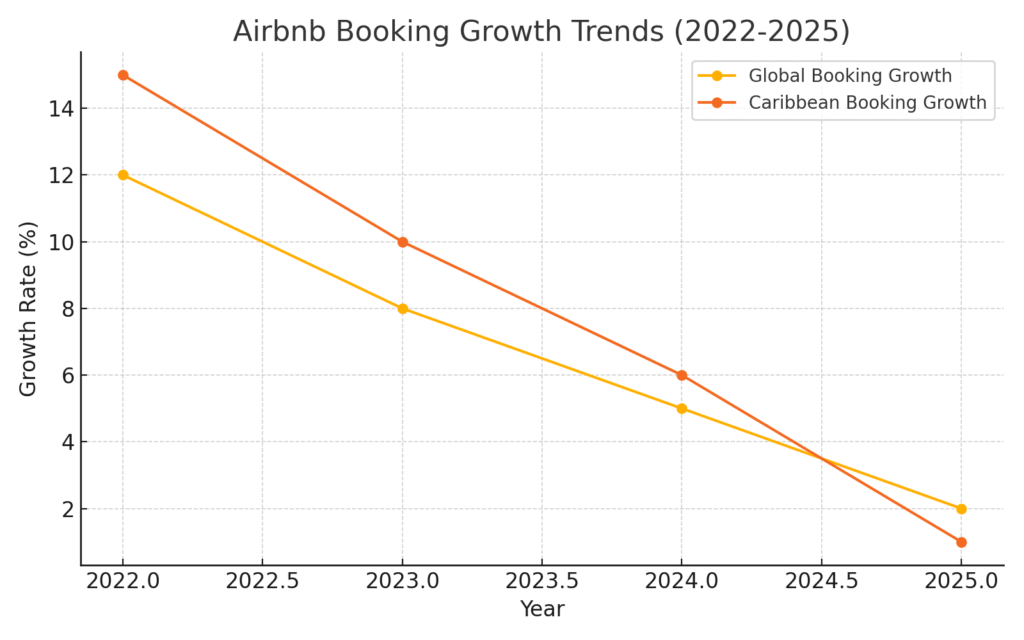
Recent industry signals indicate a slowdown in booking growth compared to 2022–2023. While travel demand remains, the distribution of bookings is shifting: guests are more price-sensitive, they’re browsing alternative platforms, and some markets are saturated with new listings.

For the Caribbean specifically, fluctuations in seasonal travel patterns and currency exchange rates can have an outsized impact on demand.

Global growth is slowing and the Caribbean has seen a steeper drop in 2025.

2) Why this is happening in 2025

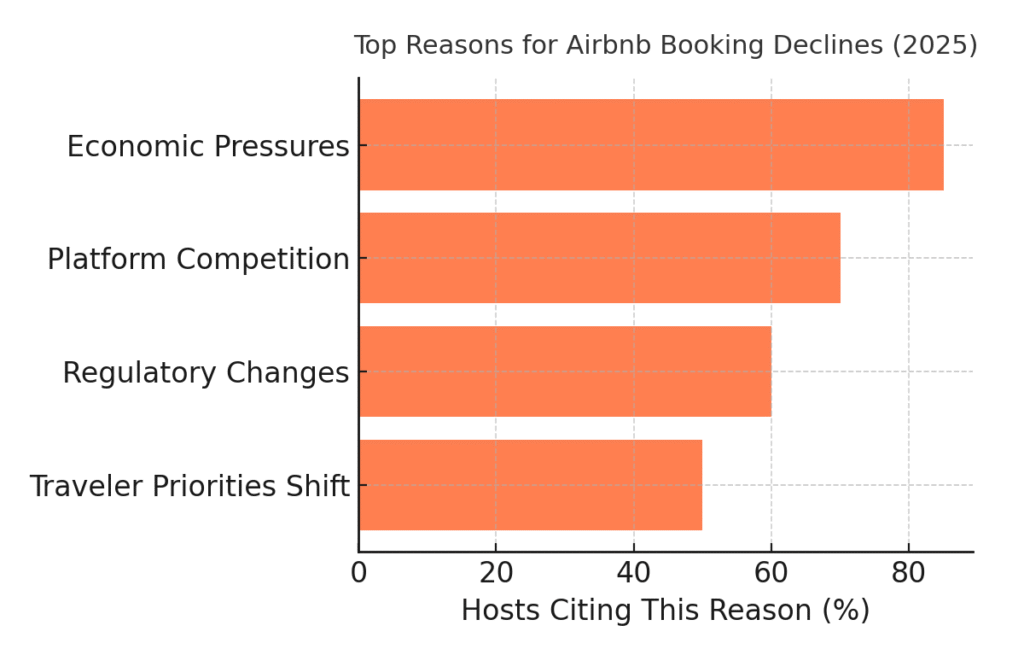
  • Economic pressures: Rising costs of flights, food, and entertainment push travelers toward shorter trips or different destinations.
  • Platform competition: Guests are cross-shopping between platforms, and discount-led merchandising can shift visibility and demand.
  • Regulatory changes: New short‑term rental rules in some cities/countries are capping supply or adding compliance costs.
  • Traveler priorities: Post-pandemic, experiences, safety, and flexibility are valued over traditional amenity lists.
Economic pressures rank first, followed by platform competition and regulatory changes.

3) The Caribbean host perspective

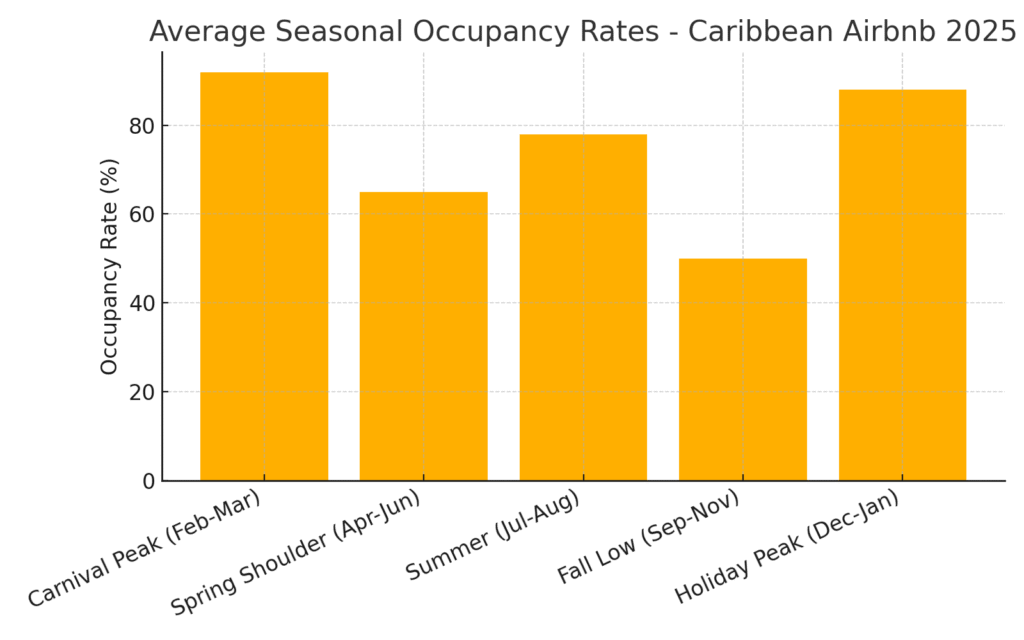
In Trinidad & Tobago and across the region, hosts face unique dynamics: seasonal peaks tied to Carnival and the holidays; a large share of diaspora travelers; and under‑marketed shoulder seasons. When global patterns shift, Caribbean hosts tend to feel the effects quickly.

4) How to protect your income in 2025

  1. Optimize pricing: Use dynamic pricing tools to stay competitive without racing to the bottom.
  2. Diversify platforms: List on multiple platforms and build a direct booking website to reduce platform risk.
  3. Elevate experiences: Add curated activities, local partnerships, and premium touches that win conversions even at higher rates.
  4. Targeted marketing: Focus on niche segments (eco-tourists) with tailored offers.
  5. Drive repeat stays: Incentivize past guests with loyalty perks or exclusive return offers.

5) The bigger picture

While bookings may be down in some markets, hosts who adapt quickly continue to thrive. This is a prime moment for Caribbean hosts to refine their brand, expand distribution, and double down on delivering standout experiences.

5 Things Caribbean Airbnb Hosts Get Wrong, And How to Fix Them

Airbnb hosting in the Caribbean offers incredible opportunity, but it also comes with unique challenges. From infrastructure realities to diaspora traveler expectations, small mistakes can lead to big losses in revenue, ratings, and repeat bookings. If you’re a property owner or aspiring host in Trinidad, Tobago, or the wider Caribbean, here are five common mistakes hosts make, and how to fix them to achieve both guest satisfaction and sustainable income.

1. Misleading or Inaccurate Listings

Many Caribbean Airbnb listings oversell their amenities or use outdated, heavily edited photos. Guests arrive expecting one experience and get another, leading to poor reviews, refunds and cancellations.

How to fix it:

  • Use high-quality, honest property photos taken in natural light.
  • Clearly state what’s included and provide context for local norms (e.g., “Water pressure may vary during peak evening hours”).
  • Keep your amenities list and house rules updated to match what’s actually available.

2. Poor Communication and Slow Responsiveness

Guests expect fast, professional, and proactive communication especially those traveling from overseas. Inconsistent or slow replies make guests nervous about booking, or left feeling neglected when seeking assistance throughout their stay.

How to fix it:

  • Automate core messages such as booking confirmations, check-in instructions, and welcome notes.
  • Set clear expectations for issue resolution timeframes for example, “Non-emergency requests may take up to 24 hours due to local service availability.”
  • Provide an available local point of contact for peace of mind.

3. No Pricing Strategy or Optimization

Flat, static, emotional pricing leading to overpricing and/or missed opportunity to generate more bookings.

How to fix it:

  • Implement dynamic pricing tools such as PriceLabs or manually adjust rates based on market data.
  • Consider adjusting the minimum stay requirement based on the season or demand.
  • Offer discounted rates for last-minute bookings or those that fill orphan nights to incentivize guests to book and to maximize occupancy and revenue.
  • Avoid blocking days unnecessarily, which can affect ranking in search results, potentially leading to reduced visibility and fewer bookings through the OTAs.

4. Neglecting Guest Expectations Around Local Infrastructure

Many guests, especially first-time visitors or returning diaspora, don’t know about Caribbean infrastructure quirks, like occasional power outages, variable water pressure or interruption, or keyed entry systems.

How to fix it:

  • Add infrastructure notes directly to your listing (e.g., “Keyed entry only. Backup power via generator. Water tank for steady supply.”)
  • Provide comfort extras such as flashlights, and portable power supplies.
  • Use pre-arrival messaging to set realistic expectations.

5. Ineffective Use of Listing Tools and Automation

Relying solely on Airbnb’s basic features leaves money and efficiency on the table. Without optimization, hosts risk lower visibility and unnecessary manual work.

How to fix it:

  • Use property management systems (PMS) to sync calendars, automate guest messaging, and track data.
  • Optimize listings with SEO-friendly keywords like “Luxury Airbnb Trinidad”.
  • Encourage reviews and feature them prominently to improve your ranking in search.

Conclusion

Caribbean hosts have a built-in advantage: stunning locations, rich culture, and vibrant experiences. But great hospitality in 2025 means going beyond location, it’s about honesty, preparation, strategic pricing, and communication that builds trust. By avoiding these five common mistakes, you’ll attract more bookings, earn better reviews, and position your property for long-term success in the competitive short-term rental market.

If you’re a property owner ready to optimized your Airbnb or short-term rental with global hospitality standards, Brief Homes International offers strategic consulting and full-service property management for professionally curated, guest-centric spaces.

Are Airbnbs Cheaper Than Hotels?

Are Airbnbs cheaper than hotels?

It Depends on What You Value.

It’s a fair question. With so many platforms, price points, and travel styles, the answer isn’t always straightforward.

The truth is, Airbnbs can be cheaper but that depends entirely on your needs, preferences, and how you define value. Cheaper doesn’t always mean better, and more expensive doesn’t always mean more aligned.

Let’s unpack what that really means.

Price vs. Value: Know the Difference

When most people compare hotels and Airbnbs, they start with the nightly rate. But that’s not the whole story.

Yes, you may find a standard hotel room at $90/night and an Airbnb at $120/night. On paper, the hotel seems cheaper. But what do you actually get for that rate?

With the Airbnb, you might have:

  • A fully equipped kitchen
  • Multiple bedrooms or sleeping areas
  • A living space, possibly with outdoor access
  • Laundry facilities
  • More privacy and flexibility

For travelers who value independence, space, or have specific needs, that $120 may go a lot further than the cheaper hotel rate.

Who Benefits Most from Airbnb?

Certain types of travelers consistently find better value in an Airbnb.

1. Families and Groups

Hotel rooms are usually designed for two people. If you’re traveling with children, extended family, or friends, you’ll often need multiple rooms or a large suite. That adds up fast.

An Airbnb, on the other hand, might offer three bedrooms, a full kitchen, and shared living space all for less than the cost of booking several hotel rooms. Plus, it’s more comfortable and communal.

2. Guests with Dietary Restrictions

If you or someone in your travel group has allergies, health concerns, or follows a specific diet, access to a kitchen is critical. Preparing your own meals saves money and gives you control over ingredients something most hotels can’t offer.

3. Long-Term Travelers or Digital Nomads

For stays longer than a few days, hotels can become expensive and restrictive. Airbnb often offers weekly or monthly discounts, and the amenities (like laundry and kitchen access) make long stays more sustainable.

When Hotels Make More Sense

That said, hotels offer something many Airbnbs don’t: full-service convenience.

I’ve traveled solo and sometimes found that I deeply value:

  • Room service
  • Daily housekeeping
  • On-site restaurants and spas
  • Concierge support
  • Seamless check-in/out experiences

These features remove the need for planning or decision fatigue. When you’re in back-to-back meetings or just want to be pampered, paying for convenience can be worth it.

So while a hotel may technically cost more, if it aligns with your desired experience, that additional cost becomes valuable.

The Misleading Nature of the Word “Cheap”

Let’s pause here.

“Cheap” is relative. What’s cheap to one traveler might be expensive to another. And what feels “affordable” may not offer value if it doesn’t meet your needs.

Instead of asking “Is it cheaper?” ask:

“Is it worth it for the experience I want to have?”

This is where many travelers go wrong. They focus on price over priorities. But booking accommodations isn’t just a transaction, it’s part of the travel experience.

Whether you choose an Airbnb or a hotel should come down to alignment not just budget.

So, are Airbnbs cheaper than hotels?

Sometimes, yes.
But the better question is:
“Which option offers more value for your travel style?”

If you’re traveling with a group, need space, plan to cook, or want to feel at home, an Airbnb can be the better choice both financially and experientially.

If you’re craving premium service, minimal decision-making, and full-on ease, a hotel may be worth the higher price tag.

At the end of the day, the goal isn’t to spend the least, it’s to spend intentionally.

Choose what aligns with your needs, supports your lifestyle, and creates peace of mind.
That’s how you travel smart and how you book in alignment.